
Sex Offender Checks in Gulf County
The controlling source is the Florida Sexual Offenders and Predators Search, maintained by the Florida Department of Law Enforcement. Select Gulf in the county field to create a county list, search a full or partial name, or use City or ZIP Code for a narrower place. FDLE says its information comes from law enforcement, the Florida Department of Corrections, DHSMV, and registrants. That makes the state portal the public starting point, while GCSO remains the local registration and verification contact.
Prepare more than a name. Compare the photograph, aliases, age or birth information, physical description, address, classification, offense, and current status. A shared name is not proof of identity, and an empty search is not a safety guarantee. For a location question, use the portal’s address or neighborhood tools and official alerts. For a person who may have moved across state lines, add the national NSOPW search.
GCSO Registration and Verification
Florida registration occurs in person at the sheriff’s office in the county where the person resides or is located, even when that person is not under state or federal supervision. In Gulf County, confirm registration dates and procedures with GCSO at 418 Cecil G. Costin Sr. Boulevard, Port St. Joe, or (850) 227-1115. The office is the practical channel for reporting suspected failure to register, an address concern, or another possible compliance problem. The research did not identify a separate Gulf County registry map maintained outside FDLE, so readers should not mistake an unofficial map for the controlling record.
FDLE also answers registry questions at 1-888-357-7332, Monday through Friday, 9:00 a.m. to 5:00 p.m. Eastern, and at sexpred@fdle.state.fl.us. These contacts matter when a profile appears internally inconsistent or a status needs explanation. Do not confront a listed person. Give the agency the profile reference and the specific fact that appears wrong or outdated.
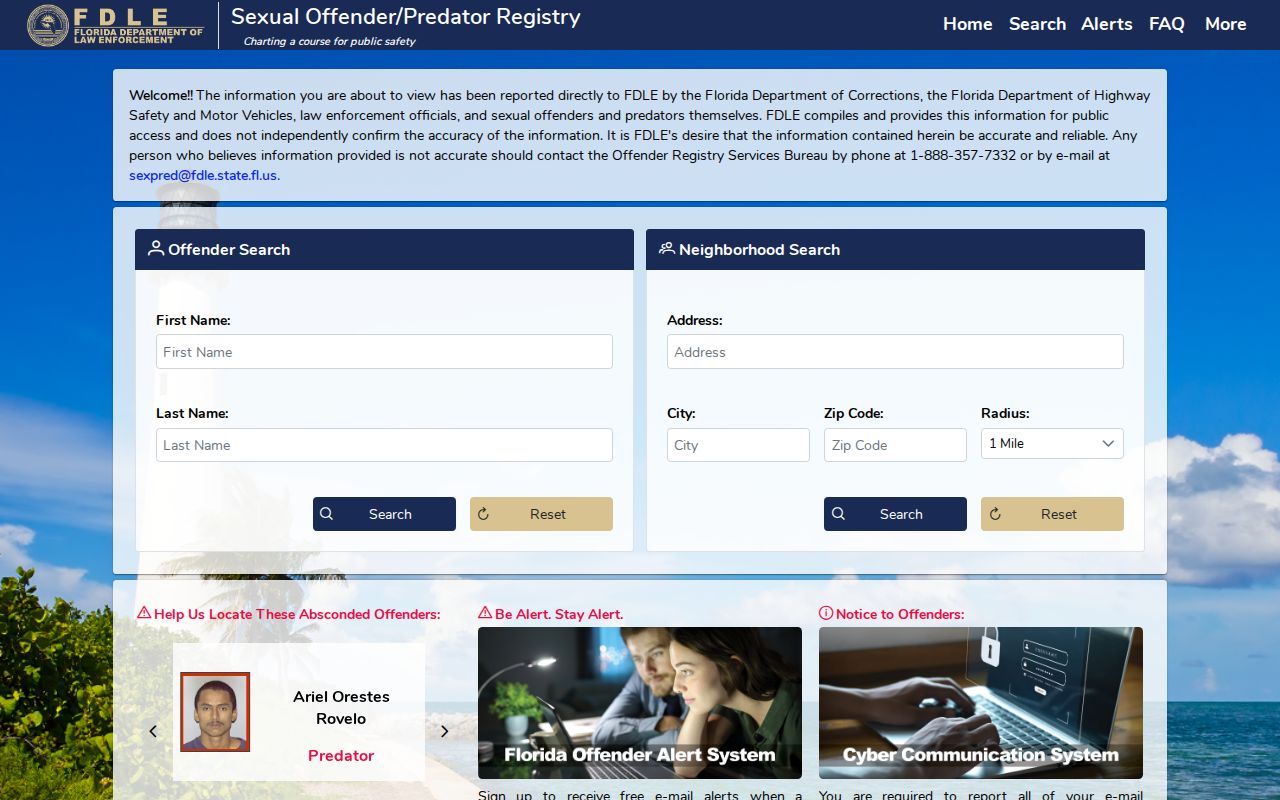
How to Search the Florida Sexual Offenders and Predators Search
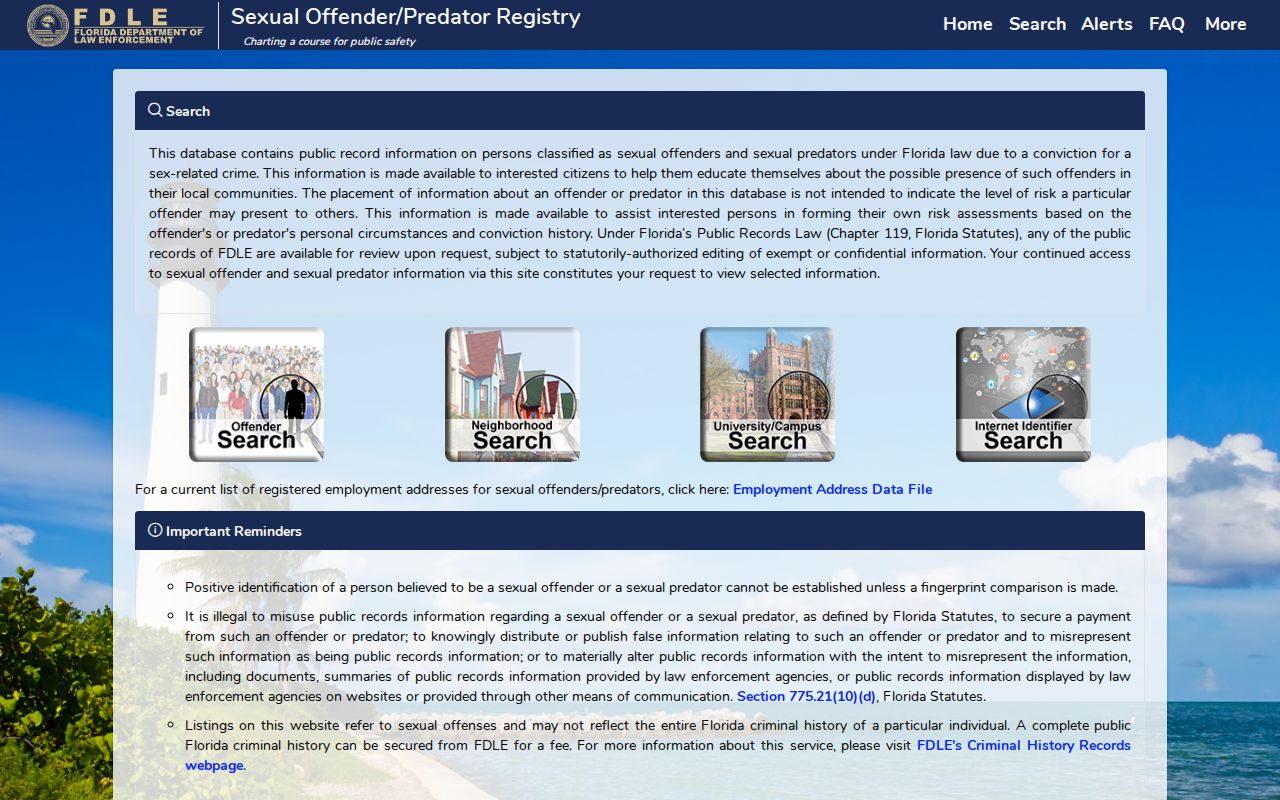
The public interface allows either a person-centered search or a geographic list. At least one of First Name, Last Name, City, County, or ZIP Code is required. Partial names are supported. Results may be selected for a printer-friendly PDF, up to 25 records at one time, and FDLE makes county or statewide public data available as CSV.
- Open FDLE Search and review the conditions of use before entering criteria.
- Choose County = Gulf for a county list, or enter a full or partial name, city, or ZIP Code.
- Compare the result photo and several identifiers; never resolve identity from the name alone.
- Open the profile and read the current status, addresses, classification, offense information, and registration details.
| Field Label | Type | Required | Notes |
|---|---|---|---|
| First Name | Text | One criterion | Full or partial name supported. |
| Last Name | Text | One criterion | Full or partial surname supported. |
| City | Text/select | One criterion | Names may be blank for a city list. |
| County | Dropdown | One criterion | Select Gulf for county results. |
| ZIP Code | Text | One criterion | Returns geographic results. |
| Select / Print | Checkbox/button | No | Printer-friendly PDF, maximum 25 selected. |
| Public Data File | Download | No | County or statewide CSV data. |
Address Searches and Official Alerts
A county list answers who is associated with Gulf County, but a neighborhood question needs the address or area-search service in FDLE’s navigation. The registry also provides email-alert functionality. Exact radius choices and alert-form fields were not exposed during research, so users should follow the live interface rather than rely on an assumed distance. An alert is most useful as notice to reopen the official profile and review its update information.
Location results require care. A profile may report permanent, temporary, or transient status, and an address may change after the search. Florida residency restrictions also depend on the offense, conviction date, governing statute, and any applicable local rule. There is no reliable universal distance that can be stated for every registrant. Confirm a specific concern with GCSO or FDLE instead of applying a generic buffer.
Inside a Registry Profile
An FDLE public profile can identify the Florida classification, status, names and aliases, photograph, date of birth or age, and physical characteristics. It may also show permanent or temporary addresses, transient status, vehicles or other conveyances when published, the underlying offense and statute, conviction place and date, release or sanction information, and registration or verification details. Read those fields together. A profile describes statutory registration information; it does not reproduce the complete court file.
| Name & Aliases | Reported legal name and known alternate names used to distinguish records. |
|---|---|
| Photo & Physical Description | Photograph, age or birth data, race, sex, height, weight, hair, eyes, and reported marks or tattoos. |
| Registered Address | Permanent, temporary, or transient location information as reported and published. |
| Offense & Statute | Offense description, jurisdiction, statute, conviction date, and related sanction information. |
| Classification | Florida sexual offender or sexual predator designation, not a generic Tier I/II/III label. |
| Registration Status | Current status and registration details, including wanted or noncompliant information when applicable. |
When Gulf County Search Is Not Enough
The National Sex Offender Public Website adds a cross-state layer when the relevant location is uncertain or a person has ties outside Florida. NSOPW does not replace FDLE for Florida details. Begin with FDLE for the controlling Florida profile, then use NSOPW to broaden a multi-state inquiry. If the national result routes back to Florida, resolve any differences through the FDLE profile and agency contact.
Likewise, a registry profile is not the same as the criminal court record. The court file may contain charging instruments, docket events, orders, and the disposition that underlies registration. Readers trying to understand that history can use the Gulf County criminal court cases channel, subject to court-access restrictions. Keep the two sources distinct: the registry answers public registration questions; the clerk file documents a particular prosecution.
Florida Registration Levels and Requirements
Florida does not present its public system as a simple three-tier display. Its material classifications are sexual offender and sexual predator, with statutory categories controlling frequency and duration. FDLE’s 2025 notice says predators and juvenile registrants reregister quarterly. Adult offenders reregister twice or four times yearly depending on the conviction. Registration obligations are generally lifelong, subject only to narrow relief available under the applicable law.
| Florida Category | Duration | Reregistration |
|---|---|---|
| Sexual predator under §775.21 | Life unless full pardon or qualifying conviction relief | Four times yearly: birth month and every third month |
| Juvenile registrant | Controlled by statute or order | Four times yearly |
| Adult offender with specified quarterly offense | Generally life; narrow petition route may apply | Four times yearly |
| Other adult sexual offender | Generally life; narrow statutory relief | Twice yearly: birth month and sixth month |
Reporting Suspected Noncompliance
Use official channels when a Gulf County profile appears out of date or conduct suggests noncompliance. Contact GCSO at (850) 227-1115 for the local verification channel or FDLE at 1-888-357-7332 for registry support. Describe the concern without circulating a conclusion as fact. Law enforcement can compare the report with information not visible to the public and decide whether follow-up is appropriate.
The registry result and wanted-status search are different views. A listed address or classification does not itself establish a new offense, and suspected noncompliance should not be treated as proven. Preserve the profile URL, the date observed, and the precise discrepancy. That gives the agency a focused lead while avoiding unnecessary exposure of personal data.
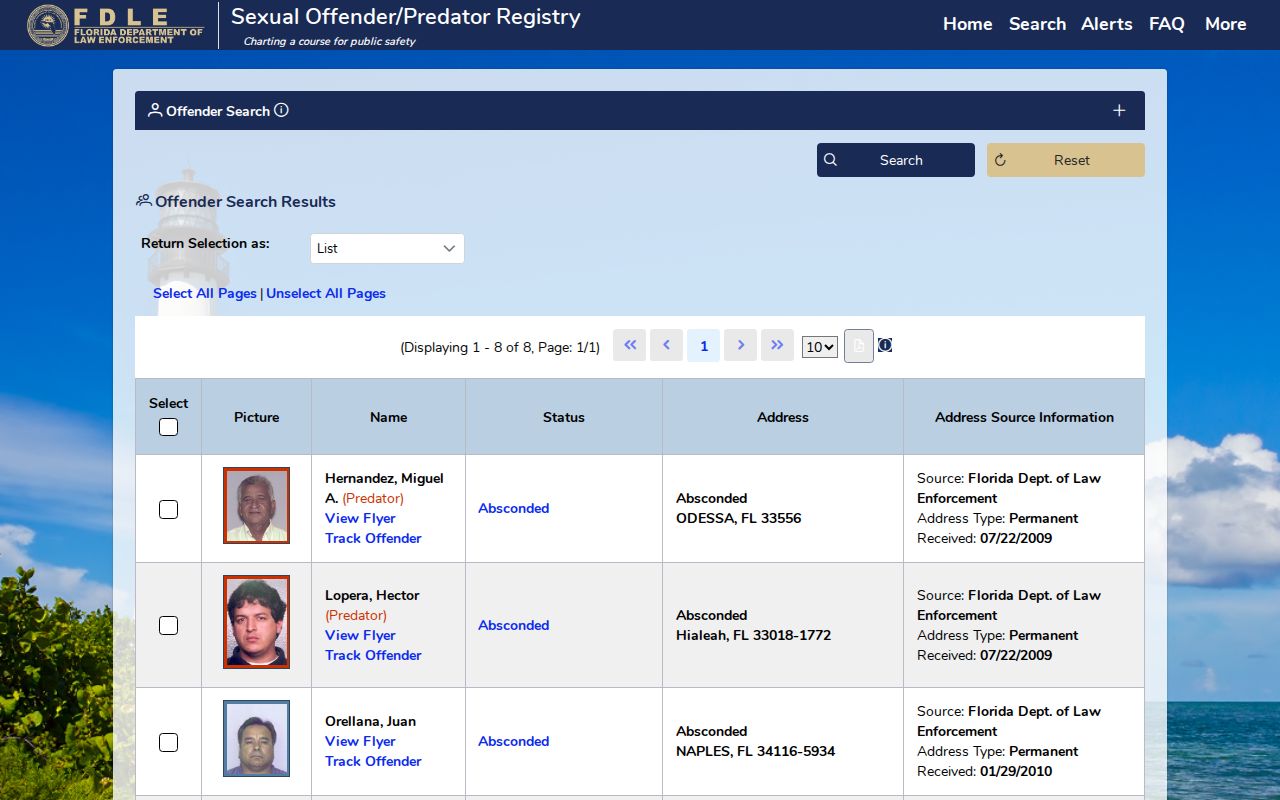
Why a Search Result Needs Current Confirmation
Registry data moves through several reporting sources. FDLE identifies information supplied by registrants, law enforcement, FDC, and DHSMV, so fields may reflect different reporting events. A profile’s update or verification details help place the address and status in time, but they do not promise that every real-world change has already reached the public screen. Save the search date when using a result for family or community awareness, and reopen the official profile before relying on it later.
An absence requires the same restraint. Search spelling variants, partial names, Gulf County, the relevant city, and ZIP Code, then use NSOPW if another state may be involved. Search criteria can miss a record, a person may not be legally required to register, or an address may be reported differently. Neither a blank result nor proximity to a listed address proves a conclusion about safety. The useful next step is an official alert or a focused question to GCSO or FDLE.
Community Notification and Lawful Use
Registry information is intended for awareness and safety planning. Use official alerts, verify current data, and report concerns rather than confronting a registrant or household. FDLE warns against using registry information to secure payment, knowingly distributing false information as registry data, or materially altering public data to misrepresent it. Harassment and vigilantism are unsafe and outside lawful community use.
Use registry information lawfully: Do not harass, threaten, intimidate, misrepresent registry data, or use it to facilitate illegal discrimination. Florida law penalizes specified misuse; confirm current information with FDLE or GCSO and leave enforcement to authorities.