Checking Criminal History in Port St. Joe
Begin with the kind of record needed, not a broad request for “everything.” A city incident narrative belongs with Port St. Joe Police Department. A booking entry belongs with Gulf County’s detention operation. A filed felony, misdemeanor, or criminal-traffic case belongs with the Gulf County Clerk. An FDLE search adds reported Florida history but does not supply the richer local report or docket.
- Identify whether Port St. Joe PD, GCSO, FHP, FWC, or another agency handled the incident.
- Ask that originating agency for its report, using the event date, place, names, and incident number if known.
- Check Gulf County’s current arrest information for a booking and custody status.
- Search CiviTek for Circuit Criminal and County Criminal or Criminal Traffic court activity.
- Use FDLE’s official name search or personal fingerprint review only when statewide coverage is needed.
Allow time for the handoff. A recent arrest can appear in booking information before the State Attorney files a case. Search name variants and return later if no case appears. A court absence does not by itself disprove the arrest.
Before relying on any result, note the source and search date. Recheck the clerk for an updated disposition and ask the originating office about an apparent error. That short verification step separates a changing public index from the office’s maintained record and reduces the risk of repeating an outdated allegation.
Requesting a Port St. Joe Police Report
The Port St. Joe public-safety page is the official starting point for city police information, and the published department telephone is (850) 229-8265. Ask the city for a Port St. Joe PD incident or offense report when its officers created the narrative. The city’s public-record request page failed at the researched URL, so the live city site or telephone channel should be used to confirm the current custodian and submission method rather than relying on a stale form.
A useful written description states the date and approximate time, location, involved agency, type of report, known report number, and preferred electronic or paper format. Florida law does not require an explanation of purpose. A focused description helps the custodian locate the correct Port St. Joe record and identify exemptions. Active-investigation material, juvenile information, protected victim details, and exempt personal identifiers may be withheld or redacted.
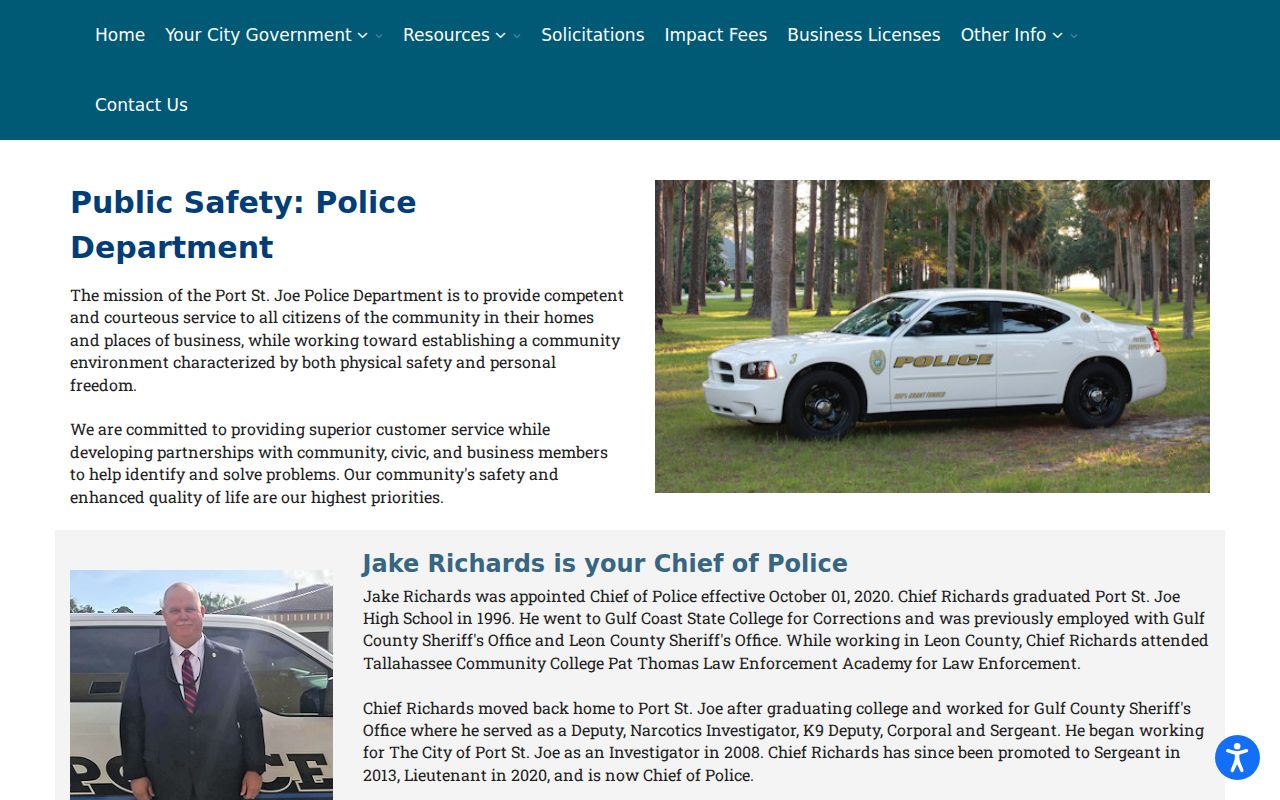
Port St. Joe Police Department Records
Port St. Joe PD records can include incident narratives, officer observations, allegations, witnesses, locations, enforcement actions, and arrest details created by city officers. The report is not the same as a booking record or a court disposition. A report states what was alleged and documented at the law-enforcement stage; it does not establish guilt. Attachments such as recordings or photographs can have separate review, redaction, or duplication issues.
Agency ownership matters in a coastal county where FHP, FWC, GCSO, and specialized state or federal agencies may work alongside city police. A Port St. Joe location does not guarantee Port St. Joe PD holds the report. Confirm the agency shown on a booking or court docket, then direct the request to that agency. GCSO’s records custodian cannot necessarily release a city-created narrative, just as City Hall does not own every sheriff investigation.
Port St. Joe’s Hurricane Fraud Record Trail
Hurricane Michael recovery produced a locally important example of multi-agency records. The Fourteenth Circuit State Attorney documented a Construction Fraud Task Force involving GCSO, Port St. Joe PD, FDLE, the Department of Financial Services, and DBPR. A December 2018 Gulf County sting led to arrests involving unlicensed contracting during a state of emergency, a third-degree felony context.
That history shows why a Port St. Joe criminal-record search should start with the actual investigating agency and then follow the court filing. One event may create a city or sheriff report, task-force material held by another participant, a county booking, and a Circuit Court prosecution. None of those records alone is the complete story. Ask for the specific document, verify which agency maintains it, and use the clerk docket for the formal case outcome.
Port St. Joe Arrests and Bookings
Port St. Joe does not have a separate public city-jail database documented in the research. Arrestees enter the Gulf County detention system, so city arrest information may split immediately: Port St. Joe PD retains its report while county custody records show booking number and time, intake charges, bond, arresting agency, custody status, and release information. Contact the Gulf County Detention Facility at (850) 227-1124 or gulfcountyjail@gulfcounty-fl.gov for records it holds.
GCSO’s Arrests page offers recent booking information, but it proves booking rather than conviction. Intake charges can be amended, declined, or replaced. If a name is missing online, ask whether the detention facility holds the older record or whether the person was booked elsewhere. The county’s full arrest lookup explains sheriff public-record requests, wanted-person information, and other county channels in greater depth.
City Narrative Versus Clerk Docket
The police narrative and court docket answer different questions. Port St. Joe PD’s report explains the reported incident and police response. The clerk docket identifies a filed case, court division, charges, events, orders, disposition, and financial information available to the public. Prosecutors may file a charge different from the intake allegation, and a charge may end separately from other counts.
Compare sources without merging them. Record the police incident number and agency, the county booking identifier if available, and the clerk case number. Then use each identifier with the office that recognizes it. This makes corrections easier and avoids treating an allegation as a judicial finding. When a clerk result includes public images, remember that index access and document-image access are not necessarily identical under Florida court-access rules.
Municipal Court Records in Port St. Joe
Florida does not use a separate Port St. Joe municipal court for the criminal case categories described in the research. Gulf County Court hears misdemeanors and criminal traffic that may result in incarceration; Circuit Court hears felonies. Both are within the Fourteenth Judicial Circuit, and the Gulf County Clerk maintains their files. City ordinance or local enforcement issues that become court cases therefore route through the appropriate county court rather than an independent city criminal docket.
| Court Name | Gulf County Court for misdemeanors/criminal traffic; Circuit Court for felonies. |
|---|---|
| Case Types Heard | County Criminal and Criminal Traffic matters; Circuit Criminal felony matters. |
| Case Lookup Channel | Gulf County Court Records through the clerk’s CiviTek link, or Room 149. |
| What the Docket Shows | Case number, filing date, status, parties, charges, events, disposition, and public images when available. |
| Copies & Fees | Clerk fee schedule applies; ask the clerk for the current cost and certification option. |
Checking Port St. Joe Cases in CiviTek
The clerk’s CiviTek gateway supports searches by Name, Case Number, and Citation Number, with criminal category and date controls where exposed. Search both Circuit Criminal and County Criminal or Criminal Traffic when the level is uncertain. Use an exact case number when known; otherwise try surname spelling variants. A citation number can be especially useful for criminal traffic.
Online results can show the local prosecution’s structure, but public image access may require a registration agreement and confidential material remains restricted. Sealed, expunged, juvenile, or otherwise confidential records should not appear as ordinary public cases. For older material or an incomplete online index, visit the clerk at 1000 Cecil G. Costin Sr. Boulevard, Room 149, Port St. Joe. The counter’s researched hours are Monday through Friday, 9:00 a.m. to 5:00 p.m. Eastern.
Where Port St. Joe Records Go
A Port St. Joe police report remains with the city custodian, while an arrest can create a county booking and a prosecutor’s filing creates a clerk case. Reported arrest and disposition data may later feed Florida’s central repository. Timing and reporting differences mean the sources may not update together.
Record flow: Port St. Joe PD › Gulf County Courts › Florida Department of Law Enforcement
For very recent activity, start with the originating police agency and county booking channel. For a filed outcome, use CiviTek and the clerk. For a statewide demographic search, FDLE charges $24, with a $1 card fee for Instant Search; those noncertified results are name-based. A person reviewing their own fingerprint-confirmed Florida record can use FDLE Personal Review.
Port St. Joe’s Cecil G. Costin Record Corridor
Several record holders are close geographically but remain legally distinct. The courthouse and clerk counter are at 1000 Cecil G. Costin Sr. Boulevard, Room 149. The State Attorney’s Gulf office is in Room 204. GCSO headquarters is at 418 Cecil G. Costin Sr. Boulevard. Proximity does not merge custody: the clerk keeps court filings, the prosecutor handles charging and victim advocacy, the sheriff keeps its law-enforcement records, and Port St. Joe keeps city police reports.
Telephone first when the desired record is unclear. The clerk’s published number is (850) 229-6112, GCSO is (850) 227-1115, and the State Attorney is (850) 229-6131. Describe the document rather than asking each office for a complete background. The response should quickly reveal whether to redirect the request.
Public Access Rules in Port St. Joe
Florida’s public-record framework generally permits requests without explaining a purpose, but it does not make every police or court detail public. The custodian may redact or withhold active-investigation information, juvenile records, protected victim-identifying information, confidential identifiers, sealed or expunged material, and other statutory exemptions. Duplication costs and a reasonable special-service charge can apply when extensive review or resources are required. Ask for an itemized estimate before work begins.
Key Statutes:
Florida Public Records Act, Chapter 119 - governs access to nonexempt records and lawful charges.
Florida Statutes §943.053 - governs dissemination of criminal justice information.
Florida Statutes §943.0585 - addresses court-ordered expunction and its limits.
If City Hall and GCSO Split the Record
When City Hall confirms a Port St. Joe police report but GCSO holds the booking, submit two focused requests instead of trying to force one office to retrieve the other’s file. Ask the city for the incident narrative and city-held attachments. Ask the detention facility for the booking record and custody information. Then search the clerk by name or case number for the judicial outcome.
Keep the results in chronological order and label each source. The arrest report may use an incident date, the jail an intake date, and the clerk a later filing date. Those differences are normal parts of the record flow. If no court case exists yet, contact the clerk later rather than treating the booking charge as the final charge. This source-by-source method preserves the distinctions that matter.