
Gulf County Criminal Court Cases
Gulf County Circuit Court hears felonies and juvenile delinquency matters. Gulf County Court hears misdemeanors and criminal traffic offenses that can lead to jail. Both courts operate within Florida's Fourteenth Judicial Circuit. A charge described as a felony should lead to the Circuit Criminal division, while a misdemeanor or qualifying traffic charge belongs in County Criminal. Court administration publishes judge and calendar information, but the elected Gulf County Clerk maintains the case file.
The clerk's public counter is in Room 149 at 1000 Cecil G. Costin Sr. Boulevard, Port St. Joe. It is open Monday through Friday from 9:00 a.m. to 5:00 p.m. Eastern. The Wewahitchka annex at 153 N. 3rd Street offers limited clerk service on Friday from 8:00 a.m. to 3:30 p.m. Central. That time-zone change matters when planning a call or visit. The clerk can be reached at (850) 229-6112, and the annex at (850) 639-2175.
Gulf County Court Divisions
The Clerk's criminal court overview gives the local jurisdiction split in plain terms.
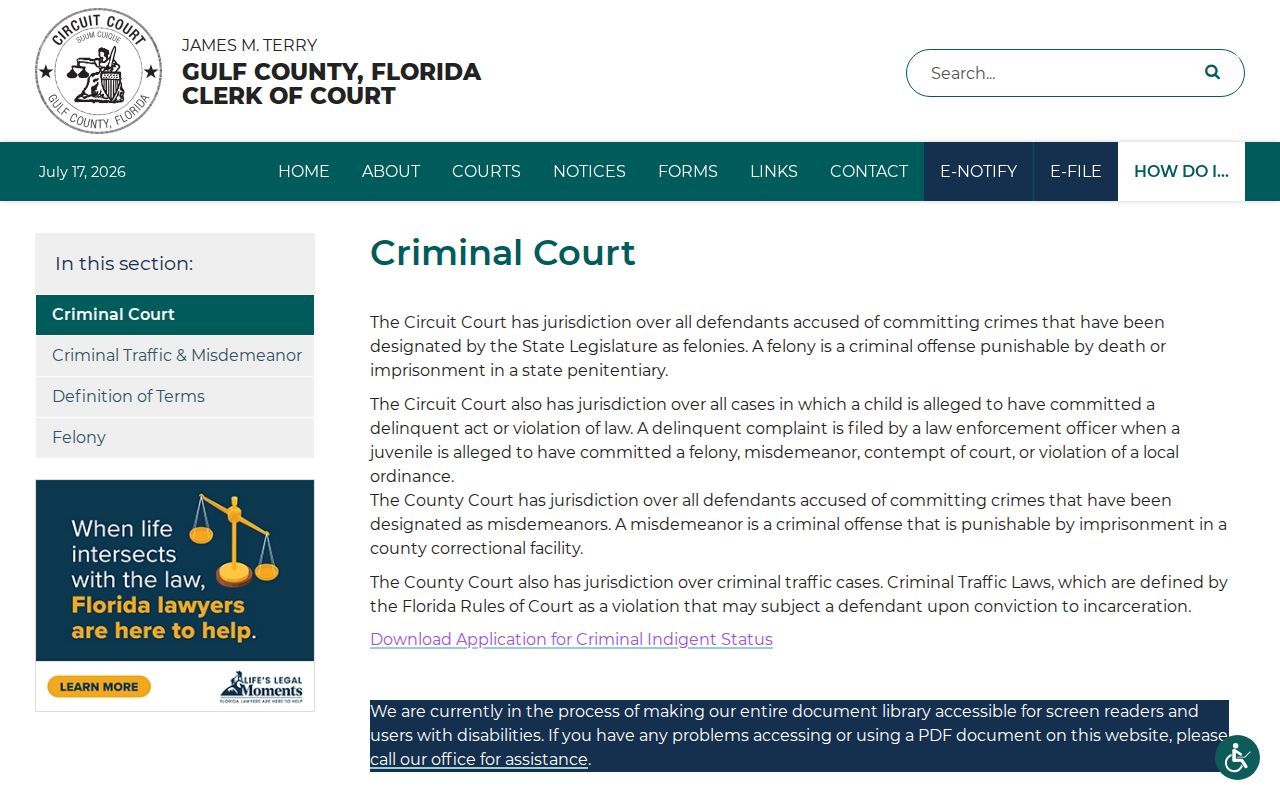
The page helps a searcher choose Circuit Criminal for a felony or County Criminal for a misdemeanor or criminal traffic file before opening the online index. That first choice avoids mistaking a blank result in one division for proof that no case exists.
| Court | Primary criminal work |
|---|---|
| Gulf County Circuit Court | Felonies and juvenile delinquency, with juvenile access limited by law |
| Gulf County Court | Misdemeanors and criminal traffic that may result in incarceration |
| Fourteenth Judicial Circuit | Judicial administration, judges, calendars, and court orders |
Searching Gulf County Case Records
The clerk's Record Search gateway links to the CiviTek Court Records Search for Gulf County. The public index works best with an exact case number. A party-name search can also work, though spelling, suffixes, and aliases may affect the results. Search both criminal divisions when the level of the filed charge is uncertain.
- Open the Gulf County Clerk Record Search page and choose “Search Court Records Online.”
- Select Gulf County, then enter the full party name or exact case number.
- Narrow results to Circuit Criminal or County Criminal and criminal traffic.
- Open the summary, read each count separately, and review docket events in date order.
- Check accessible document images, then contact Room 149 if a needed filing is not online.
| Search field | Best use |
|---|---|
| Party name | Broad search when the case number is unknown; try spelling variants. |
| Case number | Direct match to one docket when the complete number is known. |
| Court division | Separates Circuit Criminal from County Criminal or criminal traffic. |
| Filing date or status | Helps distinguish similar names and active cases from closed matters. |
Gulf County Copies and Fees
The Clerk publishes a fees and costs gateway for current copy and certification terms.
Use the current schedule instead of assuming a fee from another Florida county. Identify the case number, the exact filing, whether a plain or certified copy is needed, and the preferred delivery format. If review, redaction, or a large pull could require added work, ask for an itemized estimate before the clerk begins.
The online index does not guarantee that every filing has a viewable image. A registration agreement may govern document access. Older files, recent filings, confidential papers, or documents not yet digitized can require a counter request. The clerk contact page lists both offices and their distinct schedules.
Inside a Gulf County Case File
A docket centers on one prosecution, not the full life of a person. Its header identifies the case number, court type, filing date, and status. Party entries name the State of Florida and defendant, with public attorney roles. Each count can have its own offense description, statute, degree, offense date, and outcome, so never treat one result as the result of every count.
| Case Header | Case number, division, filing date, status, and public party data. |
|---|---|
| Charges | Count-level offense text, statute, degree, and alleged offense date. |
| Docket Entries | Chronological filings, notices, motions, pleas, capias events, and orders. |
| Hearing Dates | Arraignment, motion, plea, trial, sentencing, or review settings. |
| Disposition & Judgment | Dismissal, nolle prosequi, acquittal, adjudication, or withhold where shown. |
| Sentence & Conditions | Custody, probation, fines, costs, restitution, and later violation filings. |
Financial entries may show assessments, payments, or a balance. A document link appears only when the paper is public and digitized. Social Security numbers, protected account data, certain victim details, confidential juvenile information, and sealed material do not belong in the public view.
Reading Gulf County Docket Outcomes
Florida docket terms describe distinct events. “Nolle prosequi” means the prosecutor formally stopped a charge. A dismissal also ends that count without a conviction, while an acquittal follows a not-guilty decision. Adjudication is a formal finding of guilt. A withhold of adjudication is a sentence without formal adjudication where Florida law permits it. These labels should be read at count level and alongside the date and judgment.
A capias is a court order directing an arrest, often after a missed appearance or claimed violation. It may create a new booking tied to an older Gulf County case. A docket can also list a plea before the judgment is entered. For that reason, scan through the last disposition and sentence entries rather than stopping at the first plea or charge line.
How a Criminal Case Moves
A Gulf County case may begin with an arrest or summons. An in-custody defendant receives a first appearance, and the State Attorney then reviews what charges to file. A felony normally proceeds by information or indictment; a misdemeanor may proceed by complaint or information. Arraignment states the charge and records a plea. Discovery and motions follow before a negotiated plea or trial.
After the court resolves each count, it enters adjudication or another disposition and then a sentence when required. Appeals, postconviction filings, or probation-violation proceedings can add later entries. The booking charge may differ from the prosecutor's filed information, so the charging instrument and final court result carry more weight than the intake label.
Case flow: Arrest or summons › First appearance › Charging review › Arraignment › Discovery and motions › Plea or trial › Disposition › Sentence
When a Gulf Case Is Missing
First, repeat the name search with known spelling variants and check both Circuit Criminal and County Criminal. A filing may be recent, indexed under a different form of a name, or placed in a division that differs from the booking allegation. Older records may not have complete images online. Keep the search broad before drawing a conclusion.
The Clerk's office and annex contacts provide the next route.
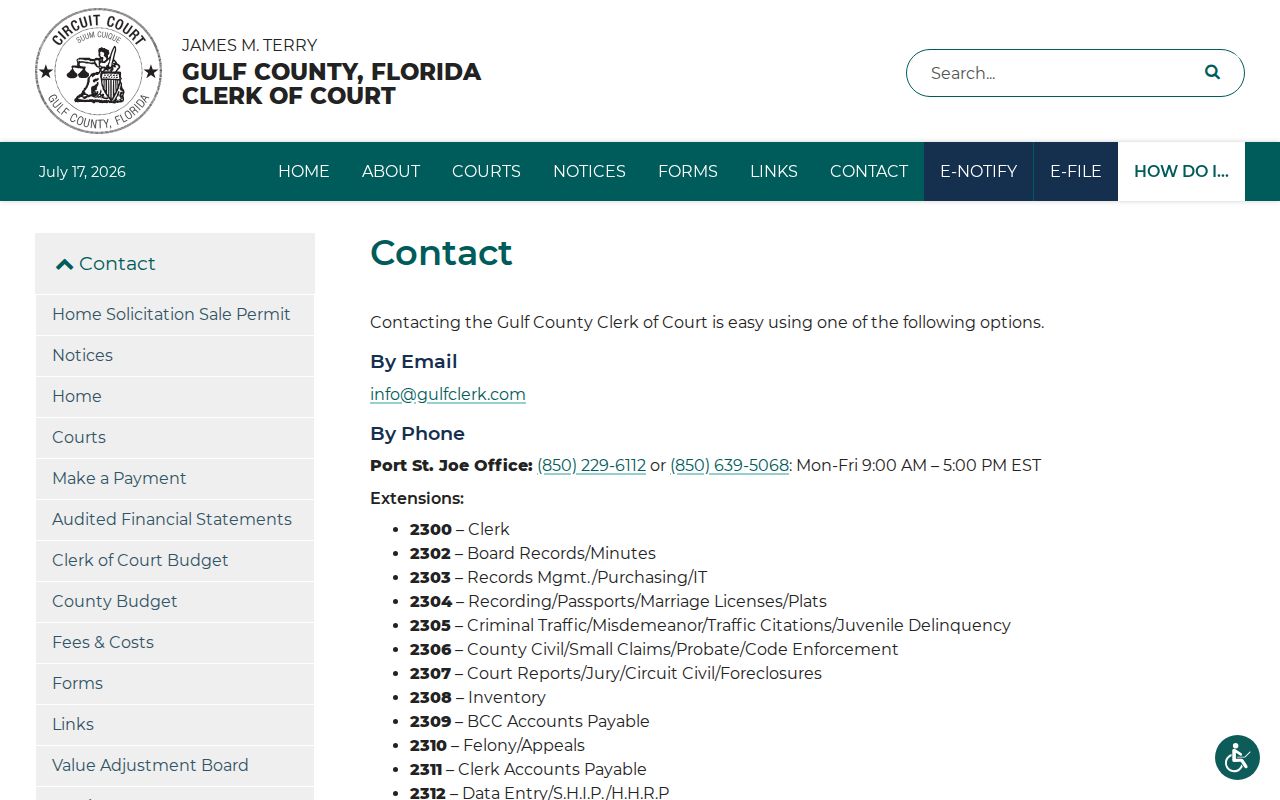
Give staff a name, approximate filing date, possible division, and case number if known. Confidential, sealed, expunged, and juvenile matters may be unavailable by law. A blank online result therefore does not prove that an event never occurred.
Gulf County Federal Case Records
Federal criminal cases arising in Gulf County belong to the U.S. District Court for the Northern District of Florida, not the county clerk database. PACER is the official federal docket and document service.
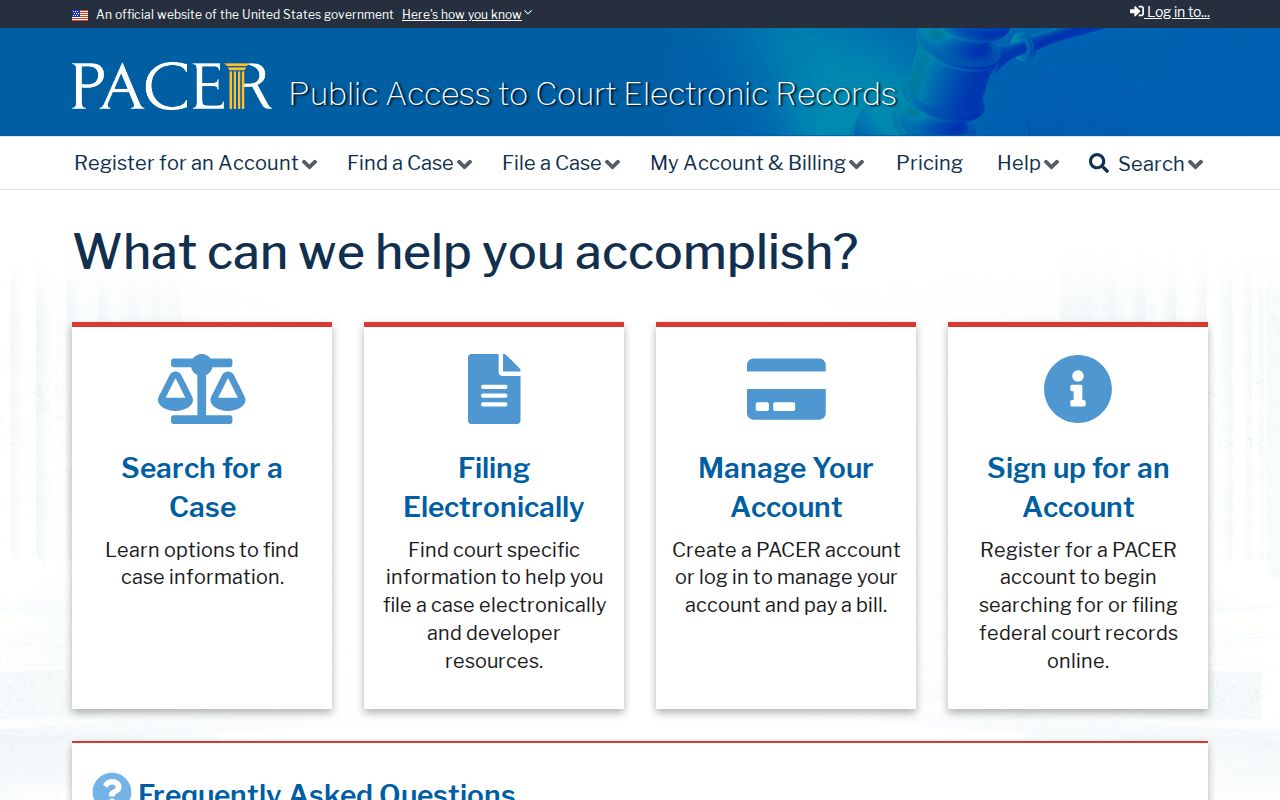
PACER requires an account and charges under the current federal schedule, subject to its published quarterly waiver threshold. RECAP or CourtListener may hold donated copies, but those are not the official court file. Search the county clerk for a state prosecution and PACER for a federal one; the two systems do not merge their dockets.
Case Record Access & Restrictions
Florida Public Records Law begins with access to nonexempt records held by the right custodian. The clerk supplies court files. GCSO supplies sheriff reports, and a city police department supplies its own incident narrative. Florida Statutes section 119.07 allows inspection and copying while also permitting lawful duplication and special-service charges. Section 943.053 governs FDLE dissemination of statewide criminal-history information.
Public access is not unlimited. Juvenile material, sealed or expunged cases, active investigative content held by law enforcement, protected victim information, and confidential identifiers may be withheld or redacted. Online access can be narrower than access to a public paper file. For review of one's own statewide history or correction of a mismatch, use the FDLE Personal Review fingerprint process and work with the contributing clerk or agency named in that record.