
Checking Criminal History in Gulf County
The best first stop for a Gulf County criminal record check is the Clerk of Circuit Court and County Comptroller's Record Search gateway. It routes readers to the CiviTek court index for local prosecutions. Search both Circuit Criminal, which covers felonies, and County Criminal or criminal traffic, which covers misdemeanors and traffic offenses that can lead to jail. A full name, spelling variants, an approximate filing range, and an exact case or citation number when known make the search more precise.
One search cannot answer every question. A court docket shows the case filed by the State Attorney, not the sheriff's narrative or current custody. Recent booking details may appear through GCSO before a prosecution is filed. FDLE adds reported Florida history, while FDC covers state prison and community supervision.
- Open the clerk gateway and follow its link to Gulf County Court Records Search.
- Search a party name, case number, or citation number, then narrow the court type and date range.
- Compare the case type, filing date, and public identifiers before treating a result as a match.
- Read each charge and disposition, then compare recent custody through official sheriff channels.
- Ask the clerk for a certified copy or use FDLE when an official statewide product is needed.
The clerk's official gateway shows how Gulf County routes online case access. The captured gateway below helps distinguish the entry page from the search interface.
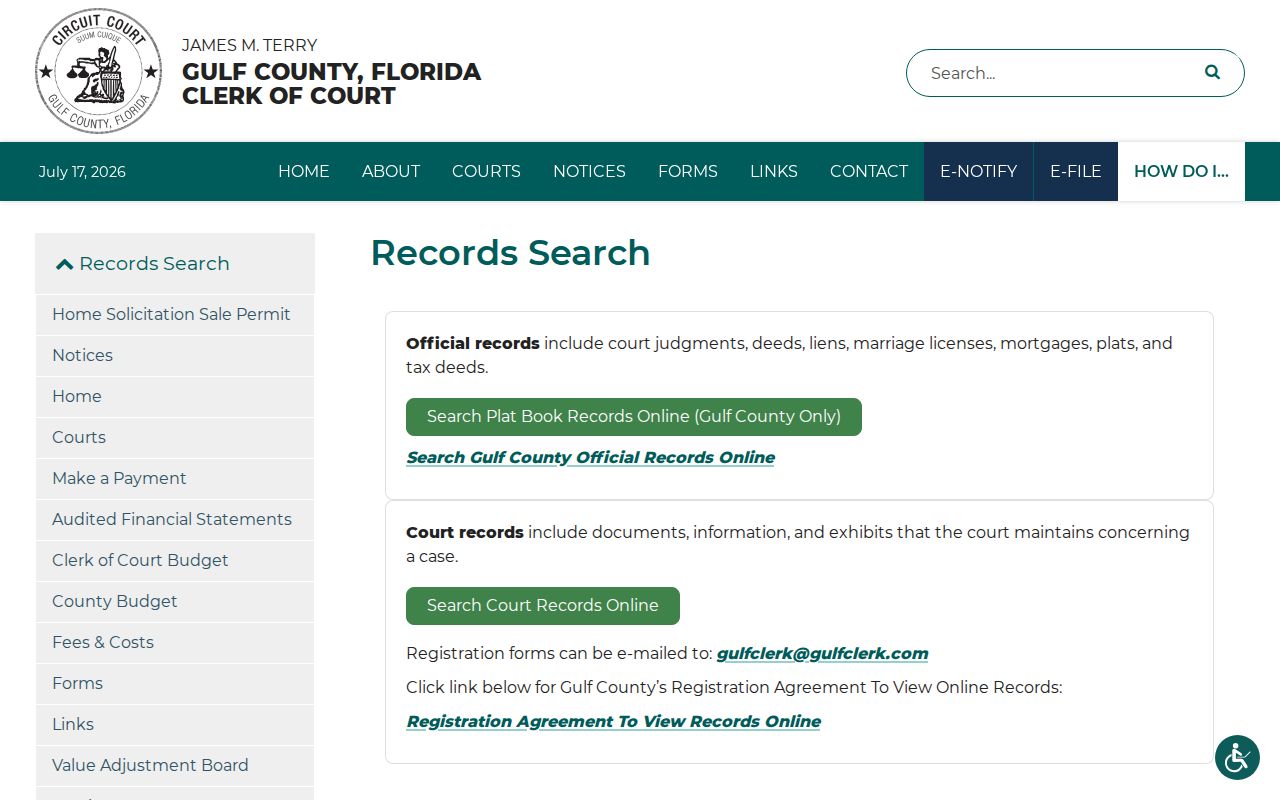
Use the route supplied by the clerk instead of an unofficial people-search service.
Four Gulf County Record Systems
Gulf County criminal records live in four main systems because each custodian records a different stage. The sheriff or city police create the incident and arrest report. Detention staff create an intake file. The clerk maintains the prosecution, and FDLE compiles qualifying Florida arrest cycles and reported outcomes. FDC begins to matter after a sentence to state custody or placement on state community supervision.
This split prevents a common mistake. A booking charge is an allegation recorded at intake, while the final court count may be changed, dismissed, or resolved through a plea or verdict. A clerk docket may remain public after release from jail. Conversely, a recent arrest may appear in sheriff data before the court has a filed case.
Local geography adds another layer. Port St. Joe is the county seat and holds the courthouse, State Attorney, sheriff headquarters, and detention contacts. Wewahitchka lies in north Gulf County and has a Friday-only clerk annex. The county's two police departments remain custodians of their own reports even though bookings and prosecutions move into county systems. Coastal roads, boating and wildlife enforcement, and hurricane recovery can also bring FHP, FWC, FDLE, or a task force into a case. When the named arresting agency is not GCSO, request the narrative from that agency first and use the county systems for the later booking and court trail.
| Question | Official channel | Record found |
|---|---|---|
| What case was filed? | Gulf County Clerk | Docket, counts, orders, disposition |
| Who made the arrest? | GCSO or city police | Incident and arrest narrative |
| Is there local custody? | Detention Facility | Booking and release status |
| What was reported statewide? | FDLE | Florida history compilation |
| Is there state custody? | FDC | Prison or community supervision |
Florida Official Background Checks
The Florida Department of Law Enforcement Division of Criminal Justice Information Services keeps the central repository. Its Instant Search is a public name-based Florida check. It costs $24 plus a $1 card fee, produces an immediate noncertified result, and charges even when no record is found. A demographic match is not fingerprint confirmation.
FDLE also processes certified and noncertified staff searches for $24. Published processing periods are five business days for noncertified results and six to seven for certified results, plus mail. For fingerprint-confirmed review of one's own Florida record and a correction challenge, use FDLE Personal Review. Authorized checks use an agency-provided ORI and an approved LiveScan provider.
The FDLE search screen shown below is the official demographic portal.
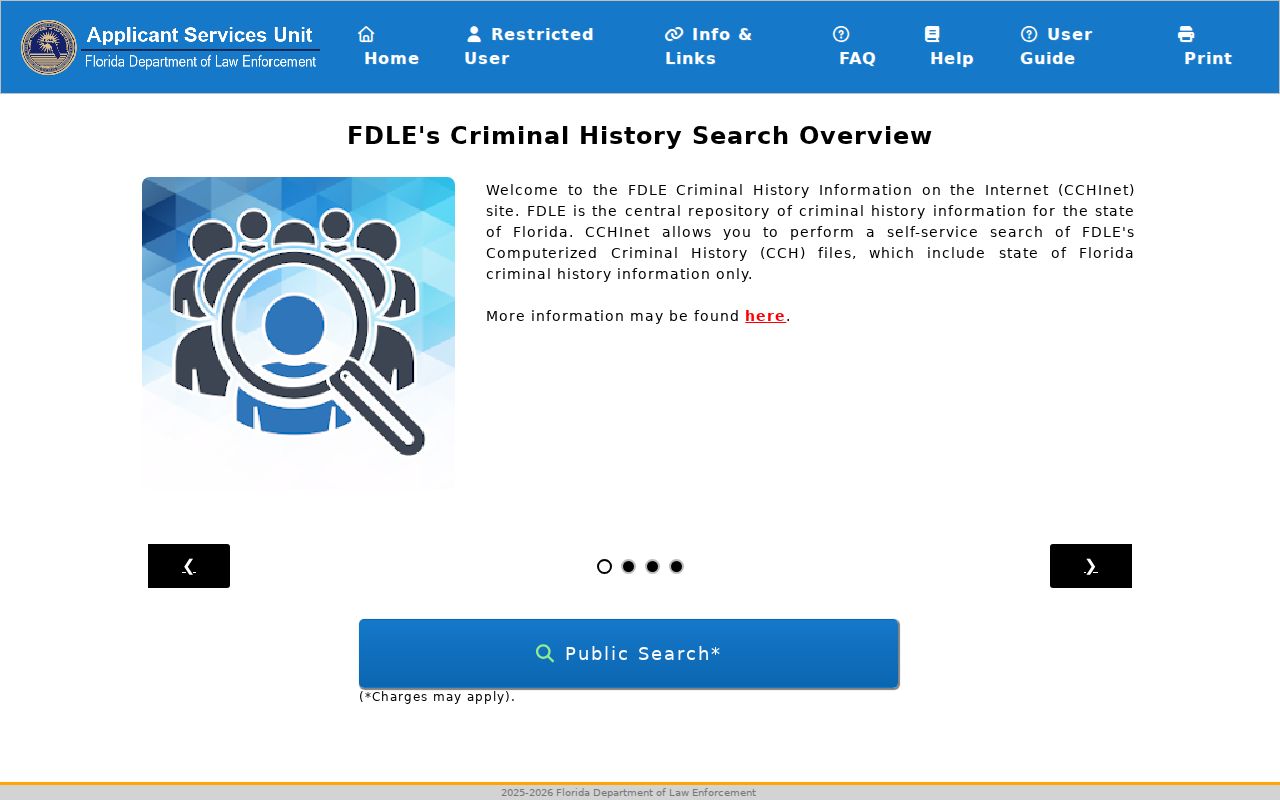
Compare the result with the Gulf County court file before relying on a charge status.
Search Gulf County CiviTek Records
The clerk-authorized Gulf County Court Records Search accepts several routes into the index. Name searches help when the case number is unknown. Exact case numbers reduce false matches, and citation numbers are useful for criminal traffic. Court-type and date controls can narrow a broad result set.
| Field | Best use | Search note |
|---|---|---|
| Name | Find an unknown case number | Try spelling variants |
| Case number | Open a known case | Use exact local format |
| Citation number | Find criminal traffic | Use the citation |
| Court type | Separate felony and county cases | Options may change |
| Date range | Limit filing period | Broaden if needed |
The CiviTek interface below is distinct from the clerk gateway. Public index access and document-image access are not always the same.
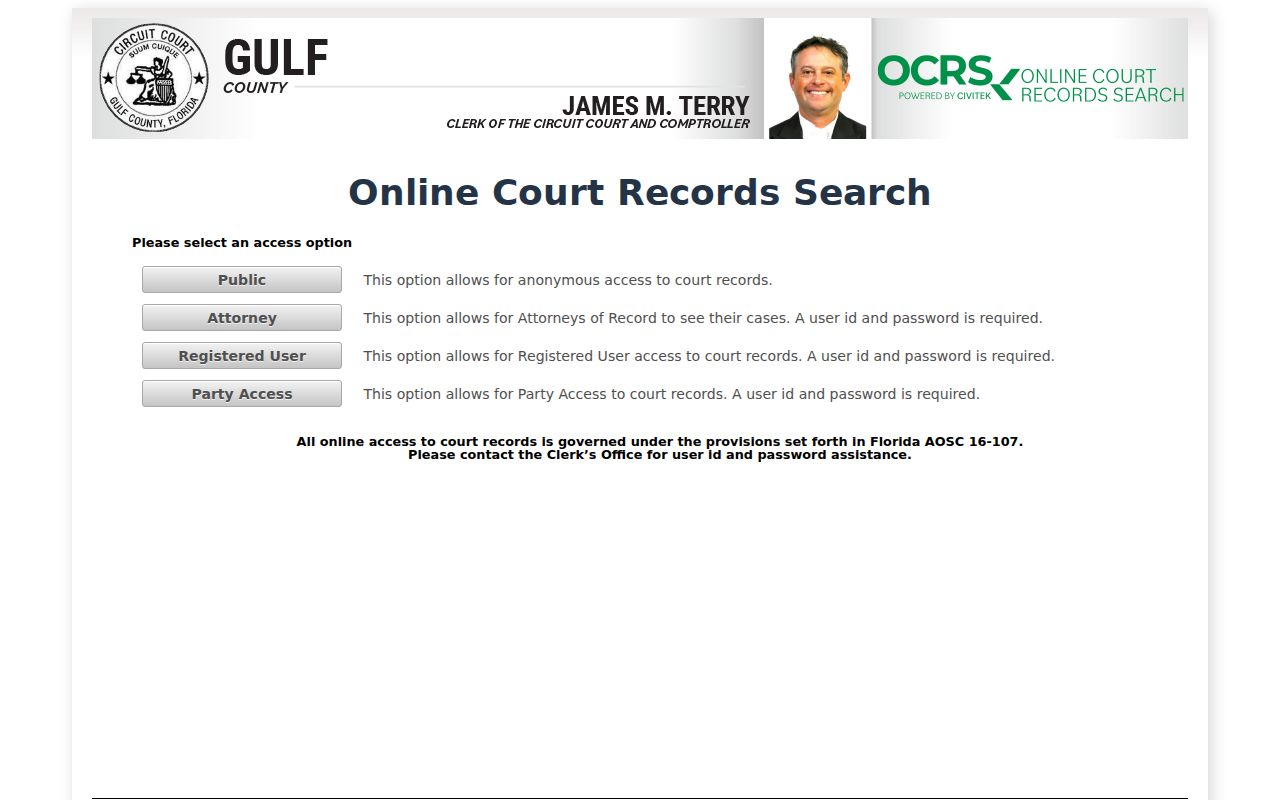
If an old, new, confidential, or restricted case is absent, contact the clerk rather than guessing what the omission means.
Criminal Record Types
A Gulf County criminal record may describe an incident, booking, prosecution, sentence, warrant, or supervision event. These are related but not interchangeable. The law-enforcement agency owns its narrative; detention staff own intake and custody data; the clerk safeguards court files; FDLE maintains reported state history.
- Incident and arrest reports describe allegations, observations, and enforcement action.
- Booking records show intake charges, bond, agency, and custody status.
- Court files hold filed counts, motions, judgments, and sentences.
- Warrant records may appear as wanted information or a capias docket event.
- State records include FDLE history, FDC custody, and registry profiles.
Restricted juvenile, sealed, expunged, and victim-protected information may not appear publicly. Absence is not proof that no event occurred.
Gulf County Records Offices
Three Port St. Joe offices handle most in-person Gulf County criminal records work. Room 149 supplies court files and certified judgments. GCSO supplies sheriff-created reports. Detention staff confirm current booking or release status.
The clerk also operates an annex at 153 N. 3rd Street in Wewahitchka on Fridays from 8 a.m. to 3:30 p.m. Central. That schedule differs from the Port St. Joe counter, which uses Eastern time. Online CiviTek access is available outside those counter windows, but an older file, a certified copy, or a question about a restricted image may still require staff help. Call the annex at (850) 639-2175 before making the north-county trip.
Clerk Public Counter
1000 Cecil G. Costin Sr. Blvd., Room 149
Port St. Joe, FL 32456
(850) 229-6112
Monday-Friday, 9 a.m.-5 p.m. Eastern
Gulf County Sheriff
418 Cecil G. Costin Sr. Blvd.
Port St. Joe, FL 32456
(850) 227-1115
Call for service details
Detention Facility
Courthouse complex, Port St. Joe
(850) 227-1124
gulfcountyjail@gulfcounty-fl.gov
Booking and custody
The Gulf County Clerk homepage identifies the clerk and court services.
Confirm counter details before travel, especially for the Wewahitchka annex.
Inside a Gulf County Criminal Record
The fields depend on the source. An FDLE history groups identity data with reported arrest cycles and outcomes. A court file centers on one prosecution, and a booking entry centers on intake. Read the source, dates, and count-level outcome before drawing a conclusion.
| Name & Identifiers | Legal name, aliases, birth date, demographic data, and state identifier where applicable. |
|---|---|
| Arrest / Booking Data | Arrest date, agency, intake charges, booking number, bond, and status. |
| Charges & Statutes | Each count, alleged offense, Florida statute, degree, and filing court. |
| Disposition | Dismissal, nolle prosequi, acquittal, withhold, or adjudication per count. |
| Sentence | Confinement, probation, costs, restitution, or other court terms. |
| Custody / Supervision Status | County custody, FDC placement, community supervision, or release when published. |
Gulf Sheriff App Record Tools
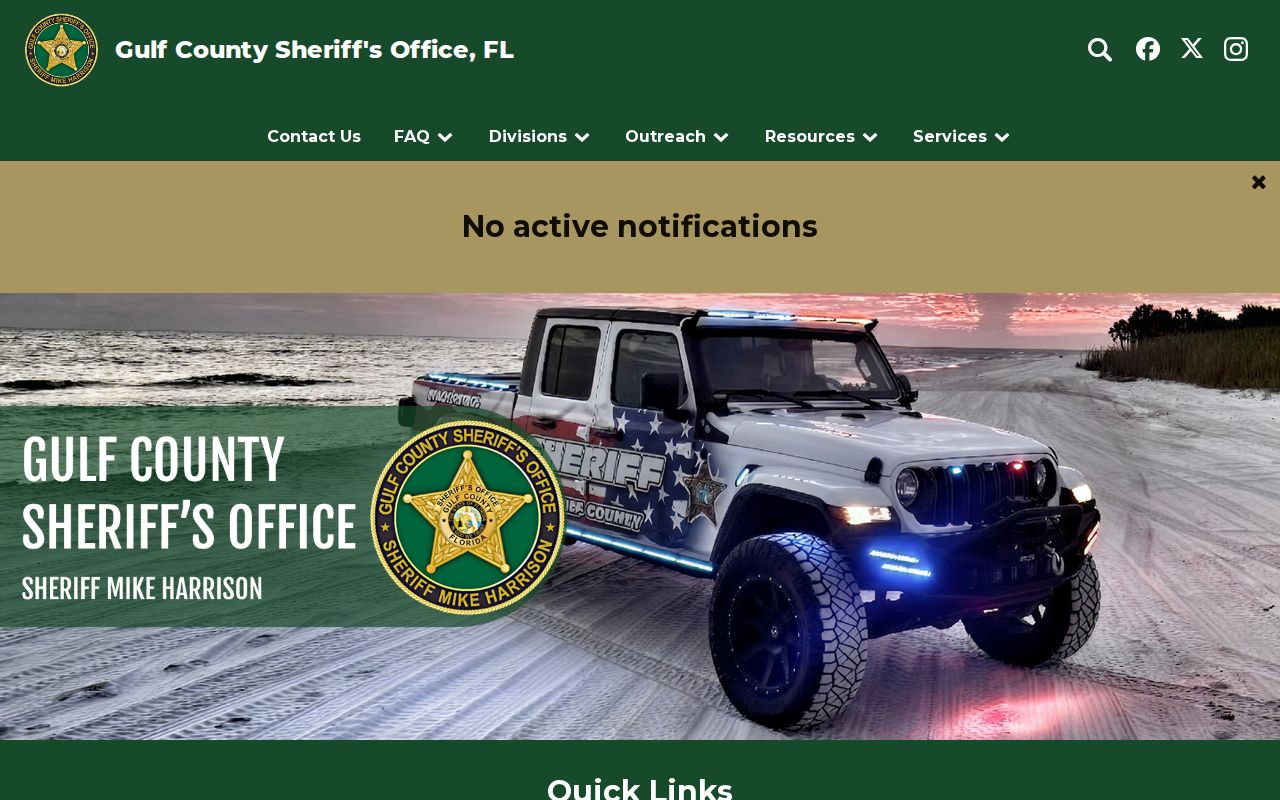
The official Gulf County Sheriff's Office website links recent arrests, wanted persons, public-record requests, and contacts. Its Gulf County Sheriff's Office app advertises inmate search, sexual-offender database access, alerts, news, and tips. The app is a second official channel, not a new custodian.
For a sheriff incident report, dispatch material, body-camera video, or another agency-held file, use the GCSO public-record request. Identify an incident number if known, the date and location, the originating agency, the exact record type, and the desired electronic format. Ask for an itemized estimate when review or redaction may be extensive. GCSO does not automatically hold a Port St. Joe or Wewahitchka police narrative merely because the person was booked at the county jail.
The GCSO homepage captured below helps locate the agency's current navigation. For a time-sensitive release question, call the detention facility because online status can lag.
The official app listing confirms inmate and registry functions that the homepage does not foreground.
Public Access Laws in Florida
Florida Public Records Law starts with the custodian that creates or keeps the record. A requester normally need not state a purpose. The office may charge lawful duplication costs and a reasonable special-service charge for extensive work, but it must review exemptions. Active-investigation material, juvenile information, protected victim details, and confidential identifiers may be withheld or redacted.
Key Statutes:
Fla. Stat. §119.07 - requires access to nonexempt records and permits lawful copying and service charges.
Fla. Stat. §943.053 - governs FDLE dissemination and the public fee channel.
Fla. Stat. §943.0585 - sets rules for court-ordered expunction.
Fla. Stat. §943.059 - governs court-ordered sealing.
Public access does not make every record complete or current. Verify a Gulf County record with the office that produced it.
Gulf County Warrant Cross-Checks
GCSO's Wanted Persons page is a public-awareness channel, not a proven complete real-time warrant database. A sound Gulf County warrant check combines that page with the sheriff main line, the clerk docket for capias events, the proper city agency for a missed local matter, and a focused records request. Sealed, juvenile, unserved investigative, and safety-sensitive warrants may not be public.
An arrest warrant follows a probable-cause finding. A bench warrant or capias often follows a missed appearance or court violation. A search warrant authorizes a search and should not be mistaken for arrest status. Someone resolving a suspected warrant should identify the issuing court and case, confirm holds or bond through official channels, and arrange a lawful appearance or surrender.
A capias can produce a new Gulf County booking tied to an older case. Search the case number and review the event dates instead of assuming the new intake marks a new charge. If another jurisdiction placed a hold, satisfying one bond may not cause release. The detention facility can confirm current custody, while the issuing clerk can confirm the docket entry and court status.
Note: A wanted-person card states an allegation or status, not the disposition of the Gulf County case.
Sealed, Expunged, and Restricted Records
Florida distinguishes sealing from expunction. Sealing blocks ordinary public access while specified agencies retain lawful access. Expunction generally requires removal or destruction of qualifying agency material, subject to exceptions and a limited confidential FDLE record. Neither remedy wipes every possible trace from every source.
The usual Gulf County path begins with a certified disposition and an FDLE Certificate of Eligibility application with fingerprints and required material. After certification, the person files the proper petition, affidavit, certificate, and proposed order in the court that handled the case. Eligibility depends on the exact outcome and prior history. Dismissal alone does not guarantee relief.
- Sealing
- Restricts ordinary public access to an eligible record.
- Expunction
- Removes or destroys qualifying records subject to exceptions.
- Disposition
- The recorded outcome of a charge or case.
- Withhold of adjudication
- A sentence without formal adjudication where Florida law permits.
When Gulf Records Move Statewide
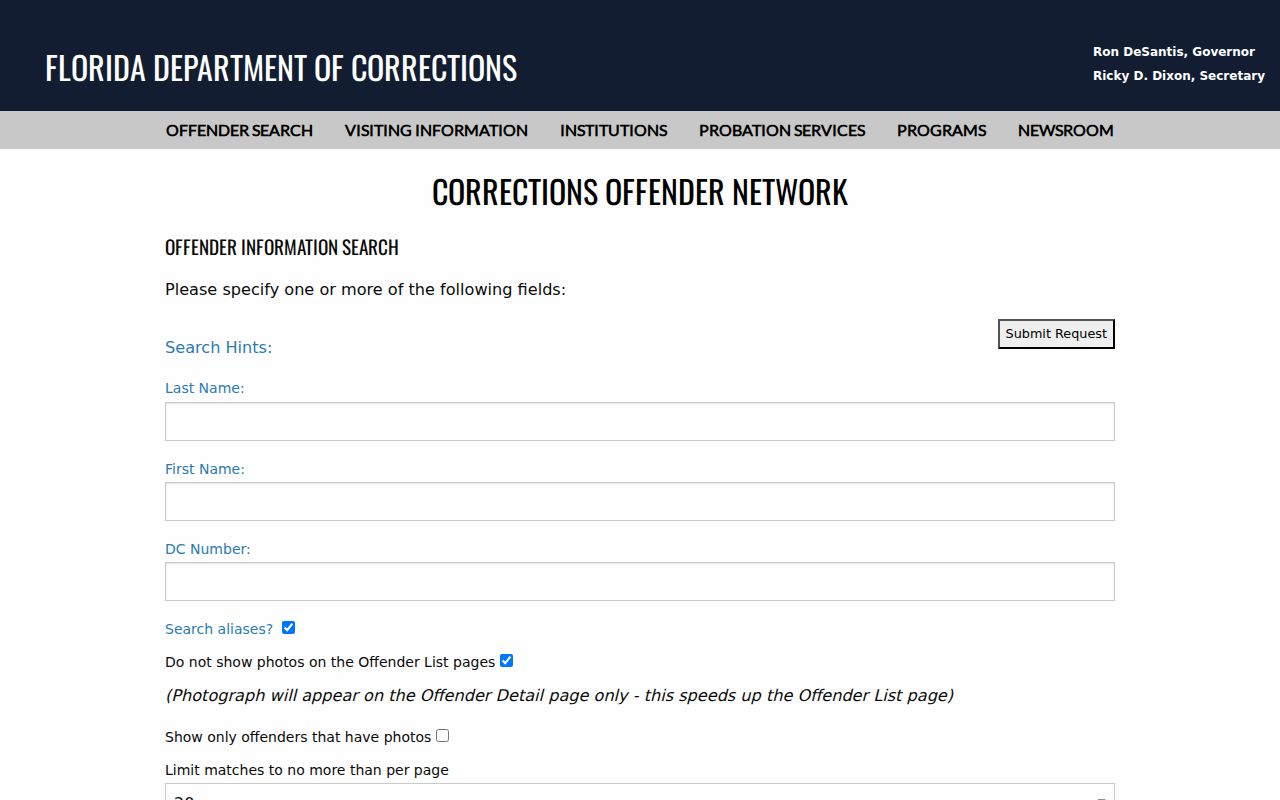
The FDC Offender Search answers whether a person appears in Florida state prison or state community supervision records. It will not reliably show a new Gulf County jail booking. The detention facility, clerk docket, and FDC system cover different stages and should be checked in that order when tracing a case through sentence.
Florida felony probation and community control are administered through FDC Community Corrections. The Gulf County court judgment remains the best source for the sentence itself, and later violation allegations appear as court filings. Do not label every supervision record as parole. The Florida Commission on Offender Review handles parole and other release functions within its authority, but many modern Florida sentences do not involve traditional parole.
The official Florida corrections search captured below accepts identity and record-number criteria.
Federal custody belongs in the Bureau of Prisons locator, while federal Gulf County dockets fall in the Northern District of Florida.
Correct Your Gulf County Record
A person reviewing their own record should use fingerprint-based FDLE Personal Review, not rely only on a public name match. The subject or designated attorney sends the form and original fingerprint card to FDLE. The result can identify the agency or clerk that contributed a disputed arrest or disposition.
The FDLE review instructions captured below explain the official correction route.
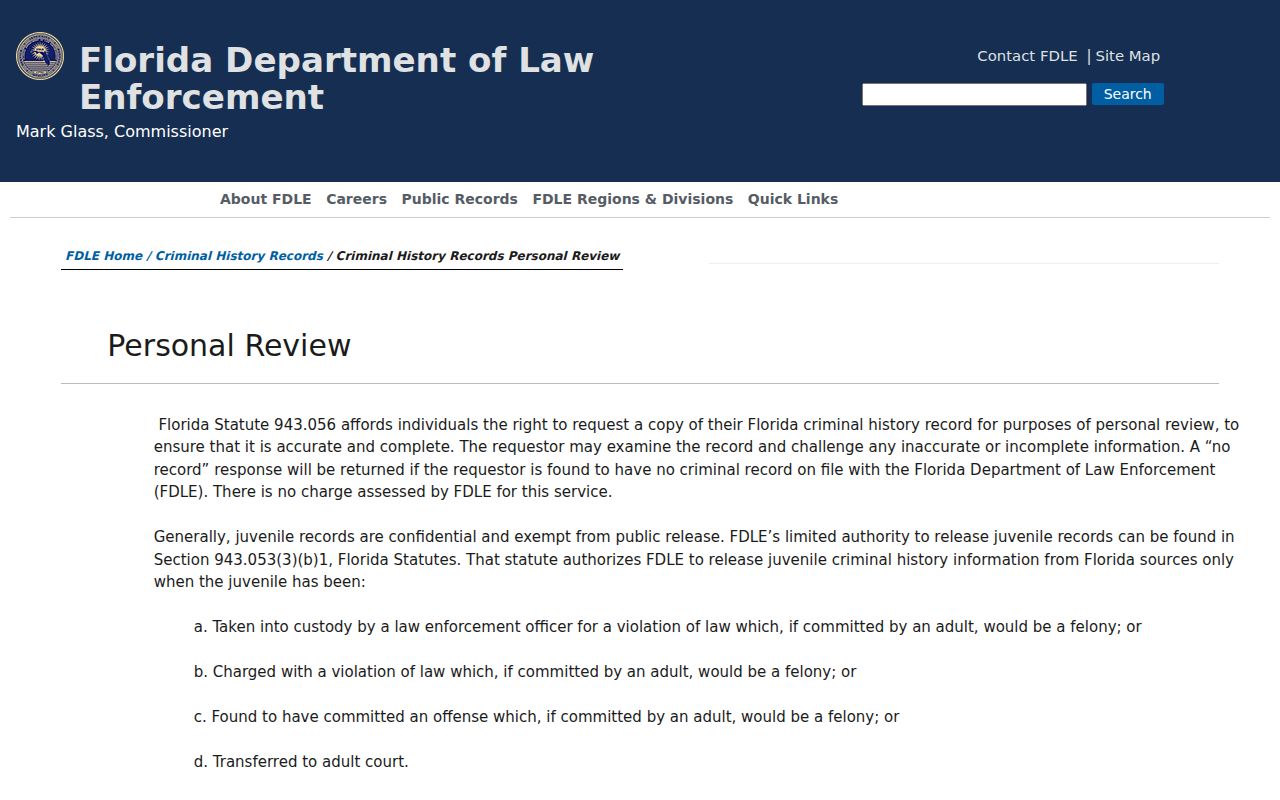
A missing court outcome may require work with both the Gulf County Clerk and FDLE because they own different parts of the record.
Gulf County Courts and Prosecutors
Gulf County Circuit Court hears felonies. Gulf County Court hears misdemeanors and criminal traffic that can result in jail. Both are part of Florida's Fourteenth Judicial Circuit. The clerk preserves the docket; the State Attorney makes charging decisions and prosecutes. That division explains why intake charges can differ from counts later filed.
The Fourteenth Judicial Circuit site captured below supplies court administration and judicial information.
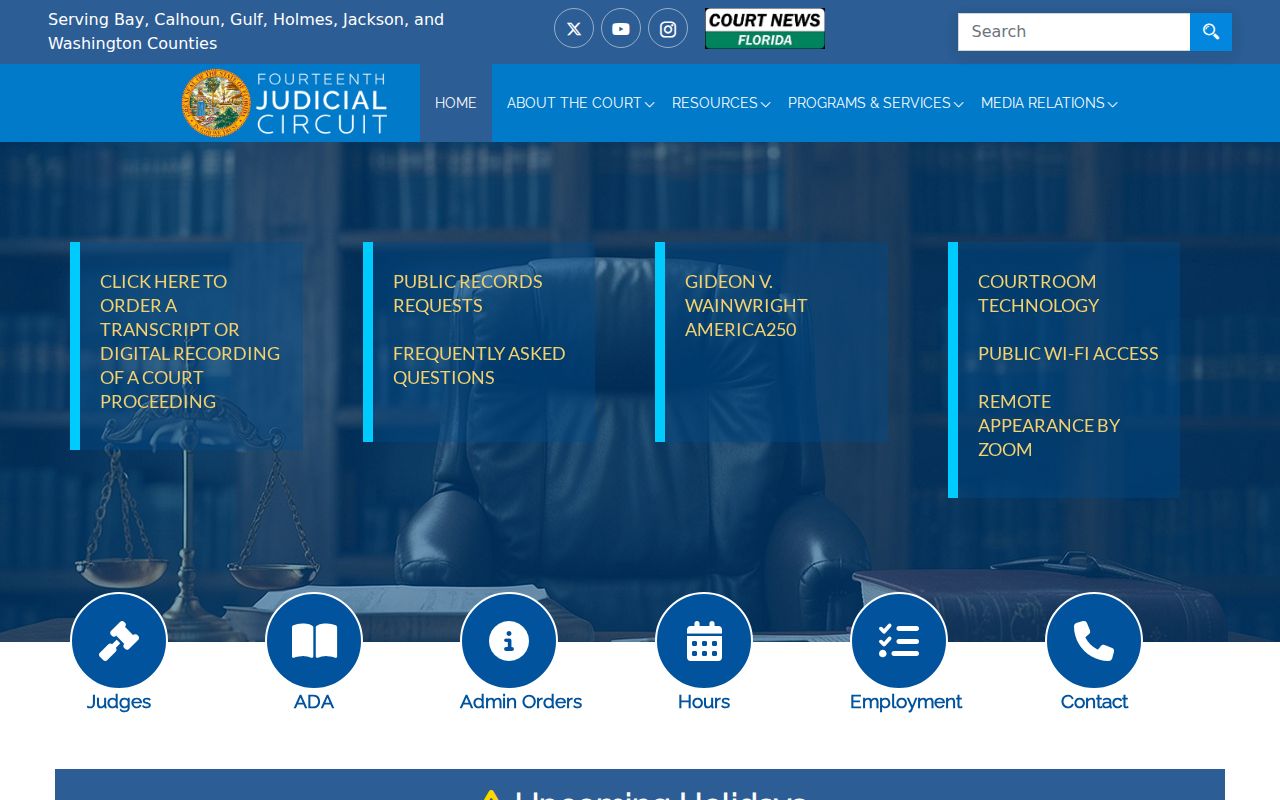
The State Attorney's Gulf County office publishes local justice contacts. Its captured page gives prosecution context rather than a case search.
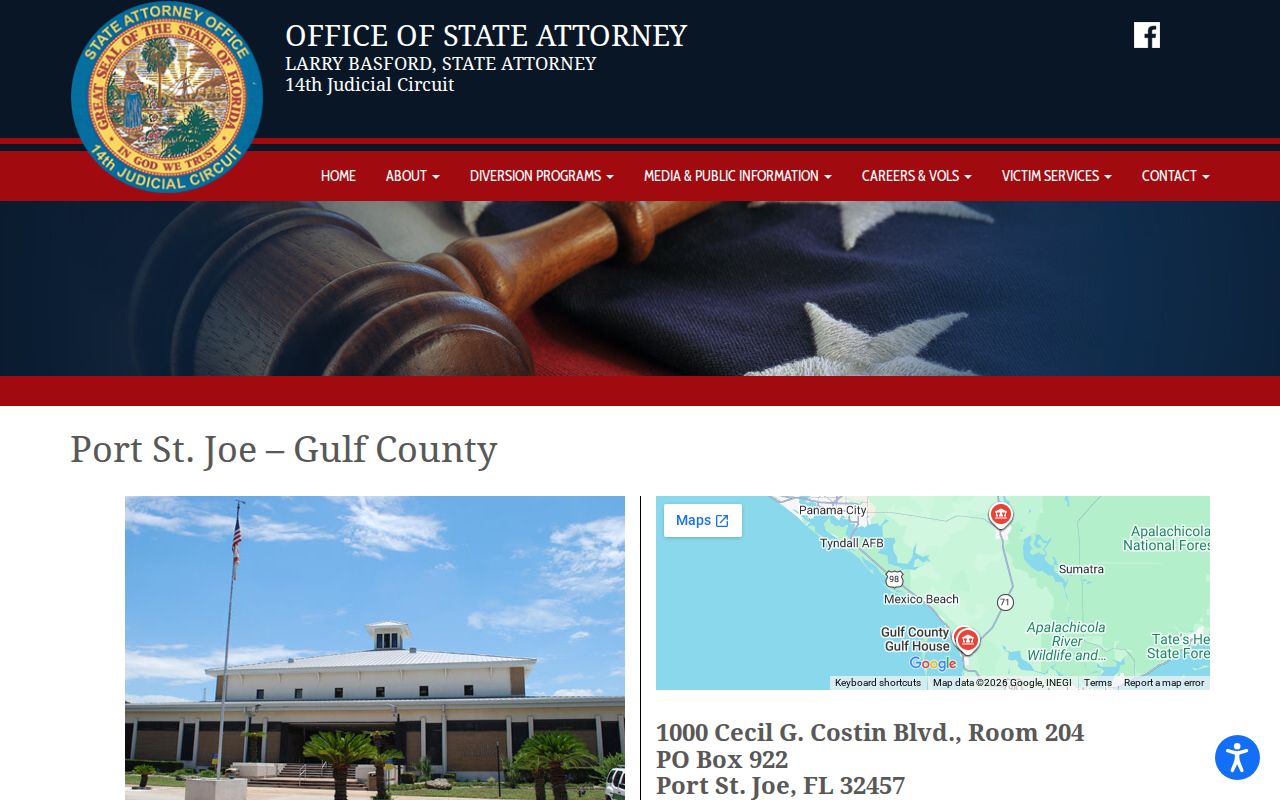
For filed events and outcomes, return to the clerk docket. Prosecutor-held records route to the State Attorney in Room 204.
Gulf County Criminal Records by City
Gulf County has two incorporated cities. Port St. Joe and Wewahitchka police keep their own incident and arrest narratives, but city arrestees route to the Gulf County Detention Facility and prosecutions route through Circuit or County Court. Neither city has a separate public criminal-history database identified in the research.
For Port St. Joe, request the police narrative through the city's official records channel, use GCSO for the booking, and use the clerk for filed charges. Wewahitchka requests begin through the city and its police contact, while the Friday clerk annex provides a local counter for court help. The arresting agency identifies who holds the report. The charge degree identifies which Gulf County court hears the prosecution.
Port St. Joe Criminal Records
2020 Census: 3,357 · Start with city police for reports, then GCSO and the clerk.
Wewahitchka Criminal Records
2020 Census: 1,891 · Use the city for reports and the Friday clerk annex for court help.